How to discover the bell curve
Canada/USA Mathcamp 2026
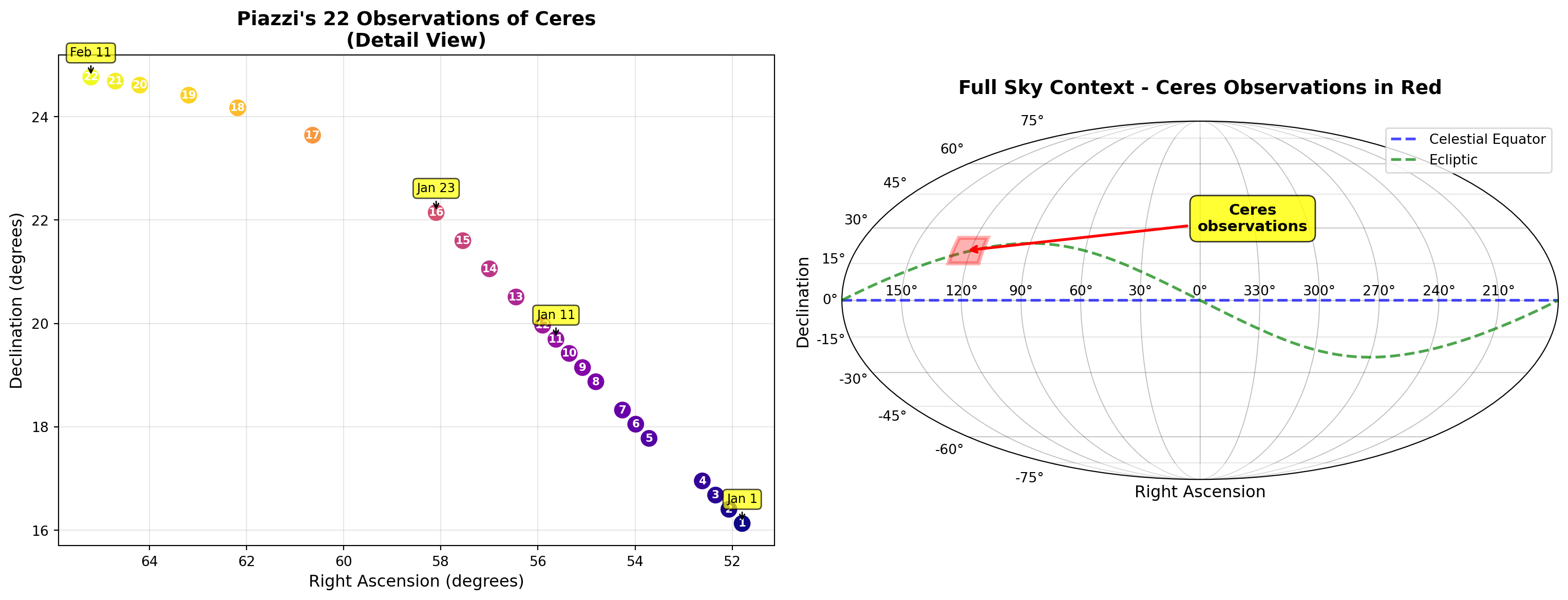
On January 1, 1801, the first asteroid, Ceres, was discovered, and just a month later, it was lost again behind the glare of the sun. Astronomers faced the challenge of calculating Ceres’ orbit months into the future using only 22 observations. Being the first object of its kind to be discovered, astronomers did not know what eccentricity its orbit should have. Many tried guessing based on their “expertise,” but Gauss solved the problem purely empirically - by analyzing data and making no further assumptions beyond Kepler’s laws.
Gauss ended up with the best estimate - the asteroid was rediscovered exactly where he predicted - and became the OG data scientist. In the process, he invented the method of maximum likelihood estimation, (not so) ordinary least squares, applied it to linear regression, and discovered his most enduring legacy - the bell curve (and some astronomy stuff). In this class, we will learn all of these things (not the astronomy stuff).
The first figure above shows the trajectory of Ceres as seen by Piazzi, the astronomer who discovered it. The second figure shows the full sky and how small the region of the sky is that Piazzi was observing. Gauss had to make a prediction of where Ceres would be in the sky based on only 22 observations in this tiny region of the sky.